

Simplifying agitator maintenance in hygienic tank systems
Agitators are critical components in many mixing processes in the food, dairy and pharmaceutical industries. They affect mixing efficiency, energy consumption and product quality — but they can also make maintenance more complex if servicing requires access to the tank.
When servicing requires access to the tank
In many hygienic tank systems, the agitator is a key part of the process. It must ensure proper mixing, consistent product quality and efficient processing of liquids, solids or ingredients in suspension.
But maintenance can be a challenge. In traditional installations, servicing seals and bearings often requires technicians to access the tank itself. This can mean longer downtime, more planning and the need for more people to carry out the service task.
In systems where hygiene, uptime and safety are important factors, choosing an agitator design that simplifies maintenance from the outset can therefore deliver significant value.
A design that can be serviced from outside
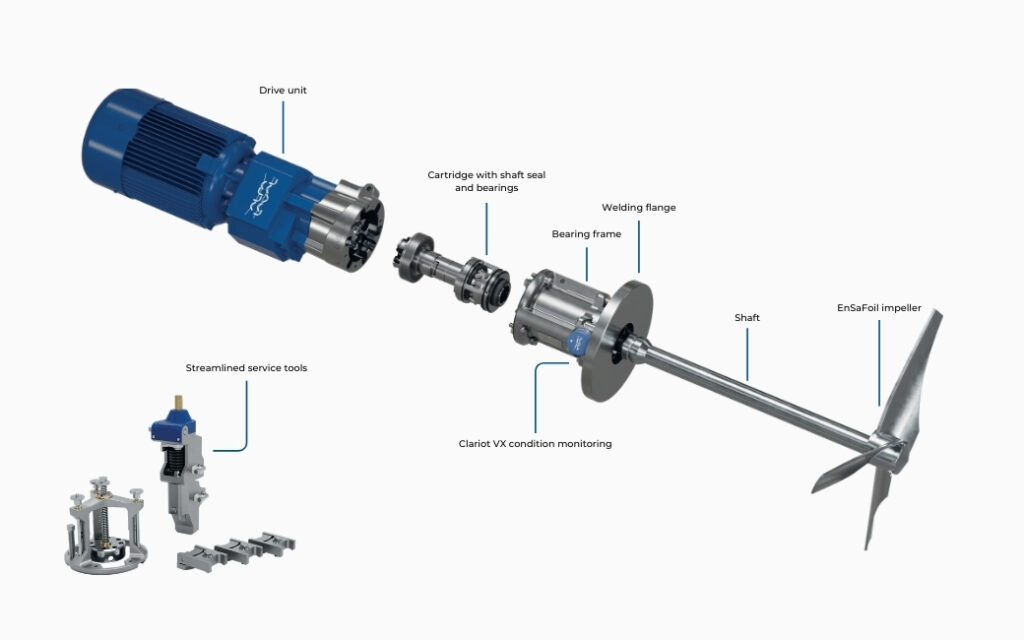
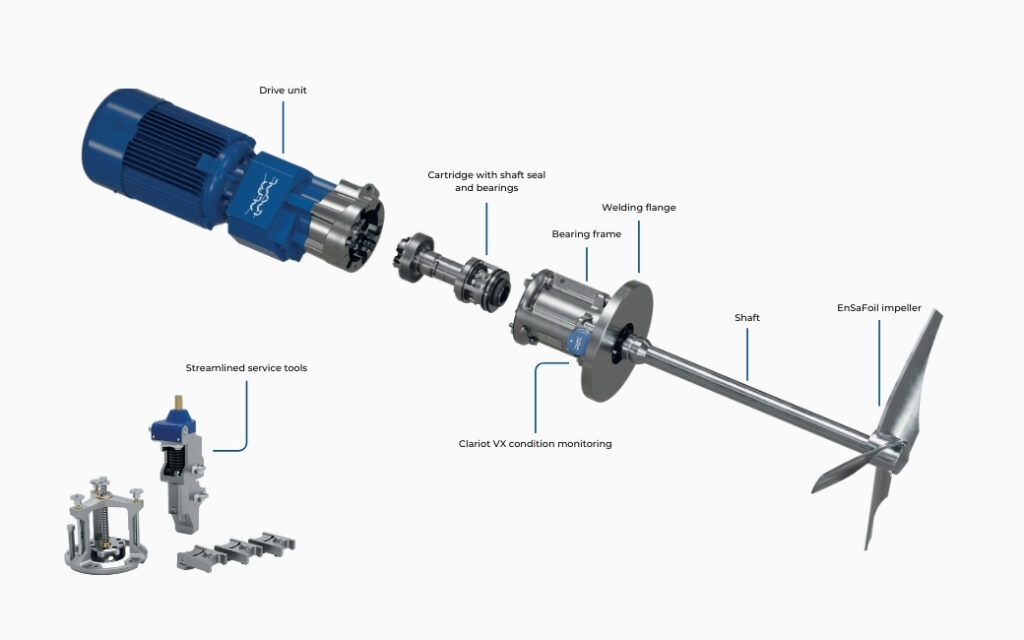
The Alfa Laval EnSaLine™ platform has been developed with a focus on easier service access and improved mixing efficiency. One of the key design differences is a bearing frame with a removable shaft.
This means that the shaft can be removed and serviced from outside. Rather than servicing necessarily requiring tank access, maintenance can be carried out more easily and with fewer resources.
In many cases, this can reduce the need for tank entry, speed up servicing and mean that only one technician is required. It also reduces the complexity of spare parts management, as the solution is based on a modular design.
How to assess an agitator solution for hygienic tanks
The choice of agitator should be based on both process requirements and maintenance needs. It is not just about efficient mixing, but also about ensuring that the solution can be serviced conveniently and safely throughout its service life.
The EnSaLine platform can be configured for different mounting requirements. ALS is used as a side-mounted agitator and is often used in storage tanks and lower-viscosity mixing processes. ALB is a bottom-mounted agitator and is typically used where bottom circulation or higher mixing intensity is required.
- Identify which process tasks the agitator needs to perform
- Assess whether the application requires liquid mixing, suspension, dissolution, fermentation or heat transfer
- Check whether servicing currently requires access to the tank
- Assess how much downtime maintenance causes
- Determine whether a side-mounted or bottom-mounted agitator is best suited to the tank design
- Consider service access, spare parts requirements and safety early in the project
- Select the impeller design based on both mixing efficiency and gentle product handling
Efficient mixing with lower energy consumption
Inside the tank, the EnSaLine platform uses Alfa Laval’s EnSaFoil impeller design. Its distinctive shape improves pumping capacity and mixing efficiency compared with traditional pitched-blade impellers.
The impeller is also designed for gentle product handling, which is important in hygienic processes where product quality and process stability are closely linked.
Depending on the application, energy consumption can potentially be reduced by up to 80 % compared with conventional agitators. This makes the choice of agitator relevant to operation, maintenance and the overall energy consumption of the tank system.
Temperature measurement
Do you need to simplify maintenance in a hygienic tank system? Hans Buch can help assess whether a modular agitator solution is right for your application.
Do you work with mixing, suspension, dissolution, fermentation or heat transfer in tanks? Get technical advice on agitator selection, impeller design and service access.
Michael Schlüter
Sales Engineer
Peter Ronæs Dreyer
Internal Sales and Project Coordinator